
BUSINESS Essay № 001
The Extinction of Middle Management
AI isn't coming for the factory floor first. It's coming for the people who sit between the executives and the workers, the coordination class that every modern corporation depends on. The last time a communication technology destroyed a coordination class, it created the modern corporation, and that cycle is about to repeat.

In 1850, a man named Paul Julius Reuter ran a small business in Brussels shuttling stock prices between two cities with a fleet of 45 carrier pigeons. His pigeons beat the railroad by two hours, and he made a good living from that edge. Then in 1851, a telegraph wire connected the two cities, and his entire business became obsolete overnight.
In September 2023, Citigroup CEO Jane Fraser took an organization of roughly 240,000 people, looked at its thirteen layers of management, and eliminated five of them. Committees and councils dissolved overnight, and seven thousand jobs followed within months, the overwhelming majority belonged to people whose primary function was passing information up and decisions down.
She wasn’t alone.
The Flattening
Between 2023 and 2025, the largest employers in the American economy engaged in the same project simultaneously, and they were remarkably candid about what they were doing.
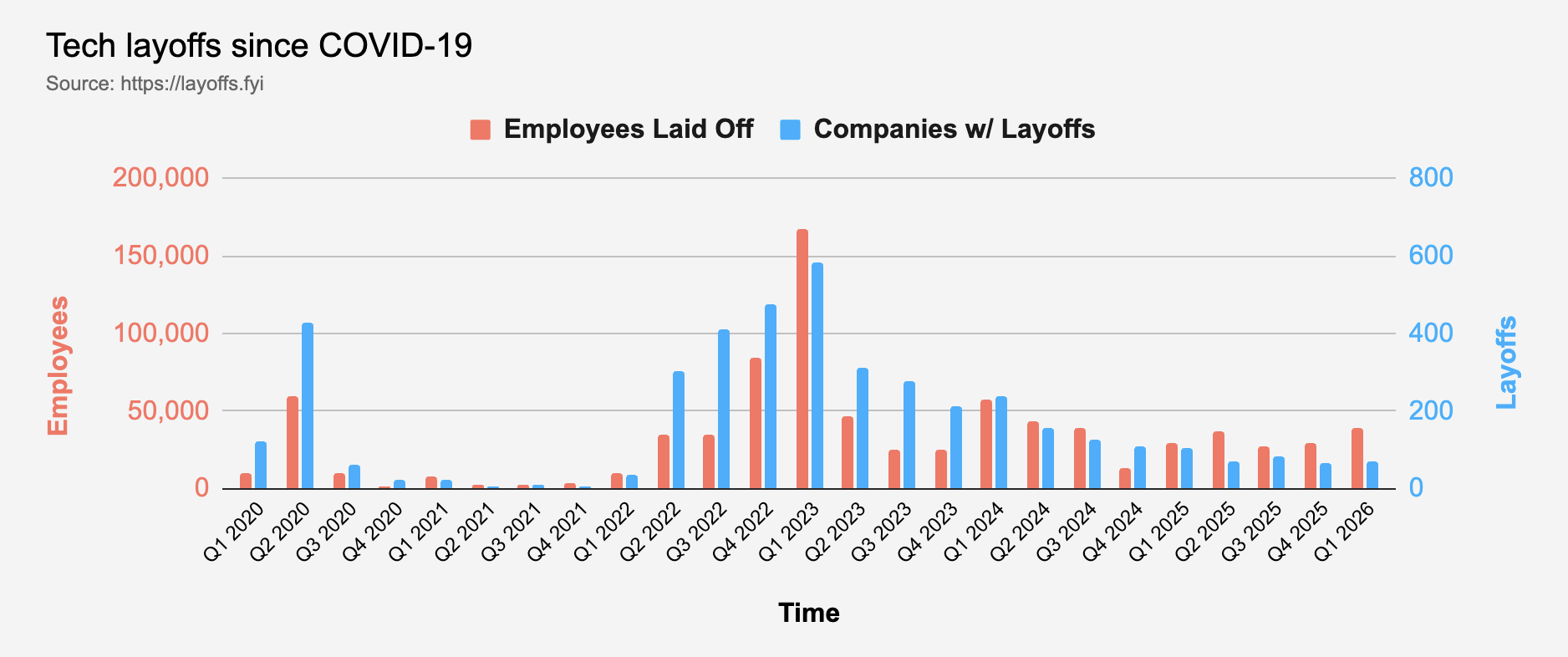
The raw numbers tell one story: a massive spike in Q1 2023 that gradually tapered off. But the composition of those cuts tells a different one. The 2022-23 wave was a correction after pandemic-era over-hiring. What followed was quieter and more targeted. The headline numbers shrank, but the cuts shifted from broad reductions to specific structural changes, flattening hierarchies, eliminating coordination roles, compressing the space between executives and the people who do the work.
Mark Zuckerberg called 2023 the “Year of Efficiency” and set about removing what he described as “managers managing managers.” Meta cut over 20,000 positions across two rounds of layoffs, with a deliberate emphasis on flattening the hierarchy. Zuckerberg’s reasoning was blunt: “every layer of a hierarchy adds latency and risk aversion in information flow and decision-making.” Managers with too few direct reports were told to become individual contributors and to go back to making things rather than coordinating the people who make things.
Then there’s Klarna. CEO Sebastian Siemiatkowski made headlines in early 2024 by announcing that the company’s AI assistant was doing the work of 700 full-time customer service agents. However, what got less attention was the structural change underneath: Klarna shrank from about 5,000 employees to nearly 3,000, with Siemiatkowski targeting a headcount under 2,000. The bigger casualty was the layer of managers who had previously coordinated those agents.
The pattern extends beyond any single company. Bloomberg reported in 2024 that middle managers accounted for 30 percent of white-collar layoffs, up from 20 percent in 2018. Gusto, analyzing payroll records from 8,500 businesses, found that manager hiring fell 40 percent from its 2022 peak while individual contributor hiring dropped only 11 percent. McKinsey’s own survey of middle managers found they spend nearly half their time on nonmanagerial work, administrative tasks, individual-contributor assignments, coordination overhead, and estimated that 49 percent of management activities could now be automated by generative AI.
None of these executives are talking about bringing the layers of management back. The organizational theorist Ikujiro Nonaka once argued that middle managers were the “knowledge engineers” of the firm: they translated frontline experience into strategy and executive directives into action. Unfortunately for middle managers, that is a precise description of what companies like Anthropic and OpenAI are now selling for $20 a month. A 2025 Harvard/Wharton experiment at Procter & Gamble found that individuals with AI matched the performance of full teams without it. A Stanford study found novices using AI performed as well as veterans with six months more experience. The knowledge engineer’s job is being automated.
The economic case for the middle manager doesn’t collapse because the manager was bad at the job, but because the math changed. And this is not a new pattern. The last time a communication technology wiped out a coordination class, it created the modern corporation, and the middle manager along with it.
The Last Time This Happened
In the 1840s, a different communication technology destroyed a different coordination class, and the parallels to today are hard to ignore.
Information had always been limited by the speed of physical travel, but the explosion of global trade in the 18th and 19th centuries built an entire professional class around that constraint. These were people whose full-time job was to carry, interpret, and act on information that couldn’t travel fast enough on its own.
A merchant in Liverpool, the main English port for the cotton trade and the hub where American cotton was distributed to Britain’s textile mills, had no way of knowing what prices looked like in New Orleans until weeks after the fact. So international trade filled the gap with a class of human intermediaries who were paid to know things that distant merchants couldn’t.
Cotton brokers, known in the trade as “factors”, were the most common version. A factor in New Orleans would receive a shipment from a plantation, walk the local market, decide what price to sell at, and execute the sale, all without consulting the merchant who owned the goods. Consider the alternative: the voyage from Liverpool, England to New Orleans took 35 to 50 days by ship. A round-trip exchange of letters (send instructions, wait for confirmation) took nine to thirteen weeks. By the time a Liverpool merchant’s instructions arrived, the market had already moved. So the factor made the call, and earned 2.5 to 5 percent commission on every transaction for doing it. That commission was the price of information asymmetry: you paid someone to be your eyes, ears, and judgment in a place you couldn’t easily reach.
Aboard merchant ships, officers called supercargoes served the same function at sea. Once a vessel left port, there was no way to contact the ship’s owner, so the supercargo had full authority to buy and sell cargo in foreign ports. They were, in effect, floating middle managers. People whose entire job was to make decisions that someone more senior would have made if communication were faster.
On land, commission merchants completed the picture. They brokered deals in every trading city based on knowing what goods were available in one place and what buyers were willing to pay in another. The entire system ran on information gaps, and every intermediary extracted a fee for bridging them.
That is, until the 1840s, when the electric telegraph made information travel at the speed of light instead of the speed of sail.

The telegraph compressed all of this into irrelevance. Richard DuBoff, an economic historian, documented how commodity price differentials between American cities collapsed after telegraph adoption. Before the telegraph, wheat prices could differ by 25 to 40 percent between Chicago and New York, a spread that reflected information lag and that funded an entire class of intermediaries. After the telegraph, those differentials shrank to 2 to 5 percent, representing only the physical cost of transportation. The information arbitrage disappeared, and the people who lived on it disappeared with it.
Displacement could be abrupt. In 1850, Paul Julius Reuter ran a fleet of 45 carrier pigeons shuttling stock prices between Brussels and Aachen, bridging a gap in the telegraph network. His pigeons beat the railroad by two hours. In 1851, a telegraph line connected the two cities, and the pigeons were obsolete overnight. Reuter, to his credit, saw what was coming: he moved to London and founded what became the Reuters news agency, built on telegraph wires instead of wings.
The pattern repeated everywhere the wires reached. William Cronon described how standardized commodity trading at the Chicago Board of Trade, made possible by real-time price information, eliminated local grain brokers across the Midwest. Harold Woodman documented the collapse of the independent cotton factor system in the South as New York and Liverpool merchants gained the ability to wire instructions directly. Tom Standage, in The Victorian Internet, catalogued the broader displacement of private courier services, semaphore operators, and information runners whose livelihoods depended on being the fastest carriers of news between two points.
But here’s the part of the story that matters most for understanding what’s happening now. The telegraph destroyed one coordination class while creating the conditions for a new one.
Alfred Chandler made the argument in The Visible Hand that the telegraph and the railroad together enabled the modern large corporation. Before real-time long-distance communication, firms couldn’t effectively coordinate operations across multiple locations. The telegraph made it possible to manage far-flung operations from a central office, which meant companies could grow much larger than before. And large companies needed something that small ones didn’t: professional middle managers to handle the coordination load.
The technology that killed the cotton factor created the corporate manager. The resistance to destroying one coordination class got channeled into building its replacement, with centralized middle management taking the place of distributed information brokers.
AI is now doing the same thing to the coordination class that the telegraph created. But the need for coordination doesn’t disappear just because the people doing it get fired. The work exists, and coordination is not a solved problem. The companies that have tried removing the middle have landed in one of two places, neither of which has room for the traditional middle manager.
The Replacement Problem
If you want to know what happens when you actually remove middle management, two companies have already run the experiment.
Zappos adopted holacracy in 2013, a management philosophy that eliminates traditional job titles and reporting hierarchies entirely, replacing them with self-organizing “circles” where authority is distributed through a written constitutional document rather than a chain of command. In 2015, CEO Tony Hsieh gave employees an ultimatum: commit fully or take a buyout. About 260 people, 18 percent of the company, took the money and left. Holacracy wasn’t the only factor (a major systems migration was happening simultaneously), but employees consistently cited confusion about how decisions got made and who was responsible for what. Zappos eventually backed away from strict holacracy. The lesson was that they hadn’t eliminated hierarchy but had replaced human judgment with a 400-page rulebook, and most people found the rulebook worse than a boss.
Valve, the game company, is famous for its flat structure. Their employee handbook states it plainly: “We don’t have any management, and nobody ‘reports to’ anybody else.” No assigned projects, desks on wheels so employees can roll over to whatever team they want to join.
Former employees tell a different story. Jeri Ellsworth, a hardware engineer fired in 2013, described “a pseudo-flat structure” with “a hidden layer of powerful management.” She compared it to high school: popular kids who had acquired power, troublemakers, and everyone in between. The economist Yanis Varoufakis, during a stint as Valve’s economist-in-residence, called it an “enlightened oligarchy”: owned by a few, but those few choosing not to boss people around. The formal hierarchy was gone, but the informal one never left.
And yet, Valve makes it work. With roughly 350 people they ship hardware, run the largest PC gaming platform in the world, and generate approximately $50 million in revenue per employee. But Valve is also ruthlessly selective. They hire only senior, self-directed people and pay accordingly. Most organizations can’t do that. They have employees at every skill level who need direction, feedback, and coaching. That’s what Nonaka’s “knowledge engineers” actually did in practice: translate between the people with the vision and the people doing the work. Remove the managers without replacing them with Valve-caliber talent, and you get Zappos.
This is the dichotomy. Zappos tried the first path of replacing managers with process and rules, and the company collapsed into confusion and attrition before retreating from the experiment. At Valve, where there is nothing in management’s place, the arrangement holds only because every employee was already the kind of person who would never need a manager. In either case, the middle management class itself has no role. Like the cotton factors and the carrier pigeons, the job isn’t coming back. The coordination work will persist, but the people who used to do it are being replaced by systems, tools, and a smaller number of more capable individuals. Reuter was the coordination layer, the person whose value came from knowing which information mattered and getting it where it needed to go. When the telegraph made his delivery method obsolete, he didn’t try to find faster pigeons but built a news agency on top of the infrastructure that had just put him out of business. Most of the coordination class won’t make that jump.
Valve is 350 people. The US economy employs 130 million full-time workers. Not every company can hire only self-directed senior talent, and not every job is creative autonomy work. Hospitals, logistics companies, retail chains, and government agencies coordinate large numbers of people doing varied, interdependent work at different skill levels. You can’t run a hospital like Valve (at least that’s not the way we do it today). For most of the economy, the coordination problem remains unsolved, and the people who used to be the solve for it are being shown the door.
What Comes Next
The uncomfortable question that none of these flattening executives are answering is: what are all these people supposed to do?
David Graeber argued in Bullshit Jobs that a large portion of the modern economy consisted of work that even the people doing it suspected was pointless. Middle management was his prime exhibit. The person who schedules the meeting to prepare for the meeting to brief the executive who already read the memo. AI is now proving Graeber right at industrial scale. If a $20 monthly subscription can synthesize what a $150,000 per year manager synthesized, then the economic argument for that manager was always thinner than we admitted.
But “your job was economically unnecessary” doesn’t help anyone pay their mortgage. Tech executives talk about “flattening” and “efficiency” as if the displaced managers will simply find something else to do. History suggests otherwise. The cotton factors didn’t become telegraph operators, and the semaphore signalmen didn’t become railroad engineers. Carl Benedikt Frey documented this pattern across centuries in The Technology Trap: during the Industrial Revolution, hand-loom weavers saw wages fall 75% over 25 years while overall productivity soared. A foundational 1993 study of displaced American manufacturing workers found earnings losses averaging 25% that persisted five years later. When a coordination class gets destroyed, the people in it fall down the economic ladder, not sideways onto a new rung.
The Valve model is the future, but it’s a future with fewer seats. Companies like Klarna and Shopify are already betting on it: Shopify’s CEO told employees to prove AI couldn’t do a job before requesting headcount, with smaller teams using better tools to produce more per person. The problem is that skill and self-direction are distributed on a bell curve. The people who thrive without a manager are a small slice of the workforce. Middle managers existed because most people aren’t autonomous operators. Removing the manager doesn’t change the distribution.
This is already visible in software engineering, where job postings spiked during the 2021-2022 hiring boom and then crashed, flatlining at roughly 30% below pre-pandemic levels even as interest rates have come down.
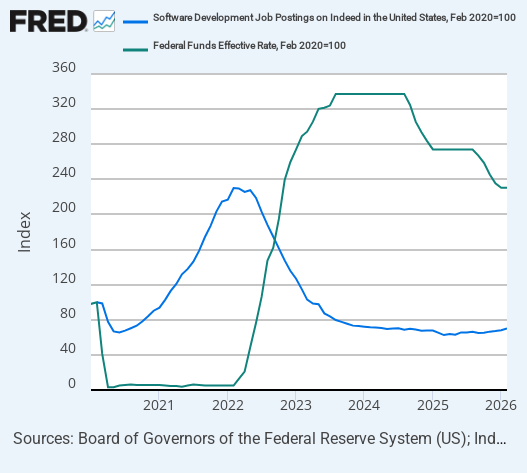
Companies don’t want to pay for employees who need mentoring when they’ve eliminated the mentors. It’s cheaper to give a senior engineer an AI copilot than to hire a junior developer and a manager to develop them. The entry-level rung of the ladder is disappearing along with the middle one.
The short-term picture is a barbell economy, with a small number of highly paid, AI-augmented professionals at the top, a large number of service and manual workers at the bottom whose jobs AI can’t yet reach, and a hollowed-out middle where millions of coordinators, administrators, and managers used to earn a comfortable living. The middle class job that required a college degree, paid six figures, and involved synthesizing information and managing people is disappearing. Not because the work was valueless, but because a machine can now do the valuable parts for less.
But the barbell is a transitional state, not an endpoint. The coordination work itself isn’t going away. Any time more than a handful of people work toward a shared goal, someone or something has to align their efforts. The telegraph proved that: it killed one coordination class and within decades, a new one emerged to handle the complexity that large organizations created. New coordination roles will emerge from this transition too. They will look nothing like middle management, and they won’t be filled by the people who held the old jobs.
Some current managers will make the transition. They will treat AI as a tool, coordinate through systems instead of meetings, and recognize that their value was never information synthesis (a machine does that now) but the judgment about what to do with it. But they’ll be a minority. The rest will face the same fate as the cotton factors and the semaphore operators: displacement into lower-paying work while the economy reorganizes around them. This transition will take a decade, not a quarter. We are currently in the early innings.
If we had to guess what the new coordination class looks like, it’s something like the organizational equivalent of an immune system: small, distributed, AI-augmented teams that form and dissolve around problems rather than sitting in permanent hierarchy. Not managed, not unmanaged, but self-organizing within boundaries set by something that isn’t a person. We’ll have more to say about this soon.
In 1851, Paul Julius Reuter watched a telegraph wire make his carrier pigeons obsolete. Instead of mourning the pigeons, he moved to London and built a news agency on the technology that had just destroyed his business. The question for every manager reading this is the same one Reuter faced: can you see what’s replacing you clearly enough to build on top of it? The companies that figure out the next coordination model will outcompete the ones still cutting headcount and calling it strategy. The ones that just flatten the org chart and call it done are like the newspaper executives who put their print edition on a website in 1997 and called it a digital strategy. They adopted the technology without rethinking the model. It took a decade for someone else (Craigslist, Google, Facebook) to figure out that the internet didn’t just distribute news faster, it changed what distribution meant entirely.
Cutting managers is the easy part. The question nobody has answered yet is simple: how do you coordinate five hundred people without a coordinator?
Sources
- 01 The Visible Hand: The Managerial Revolution in American Business — Alfred D. Chandler Jr., Harvard University Press (1977)
- 02 The Telegraph and the Structure of Markets in the United States, 1845–1890 — Richard DuBoff, Research in Economic History (1983)
- 03 The Nature of Managerial Work — Henry Mintzberg, Harper & Row (1973)
- 04 The Knowledge-Creating Company — Ikujiro Nonaka, Oxford University Press (1995)
- 05 Nature's Metropolis: Chicago and the Great West — William Cronon, W.W. Norton (1991)
- 06 King Cotton and His Retainers — Harold Woodman, University of South Carolina Press (1968)
- 07 The Victorian Internet — Tom Standage, Walker & Company (1998)
- 08 The Technology Trap: Capital, Labor, and Power Since the Industrial Revolution — Carl Benedikt Frey, Princeton University Press (2019)
- 09 Earnings Losses of Displaced Workers — Louis Jacobson, Robert LaLonde, Daniel Sullivan, American Economic Review (1993)
- 10 Bullshit Jobs: A Theory — David Graeber, Simon & Schuster (2018)
- 11 The Cybernetic Teammate — Dell'Acqua, Ayoubi, Lifshitz-Assaf, Sadun, Mollick, Lakhani et al., Harvard Business School / NBER (2025)
- 12 Generative AI at Work — Erik Brynjolfsson, Danielle Li, Lindsey Raymond, Quarterly Journal of Economics (2025)